Policy Q&A: Raising Awareness of Extreme Heat Impacts During Pregnancy
Viviana Alvarado Pacheco of The Women’s Fund Miami-Dade shares how the nonprofit has helped shift public awareness around the risks of extreme heat during pregnancy—and how to stay safe.
In our Policy Q&A series, we’re featuring a diverse array of perspectives on the many ways that science, community expertise, and lived experience can inform policy and program design to support healthy development during the earliest years.
Extreme heat can affect anyone—but it poses particular risks during pregnancy. High temperatures may result in reduced blood flow in the placenta, dehydration, and inflammation, which can trigger preterm birth. And there’s evidence that during times of high temperatures, there are increased rates of stillbirth, as well as more premature and lower birth weight babies, which are linked to greater risk for a range of adverse outcomes later in life.
Yet even in a place like South Florida, where heat has long been a part of daily life, these dangers are often overlooked.

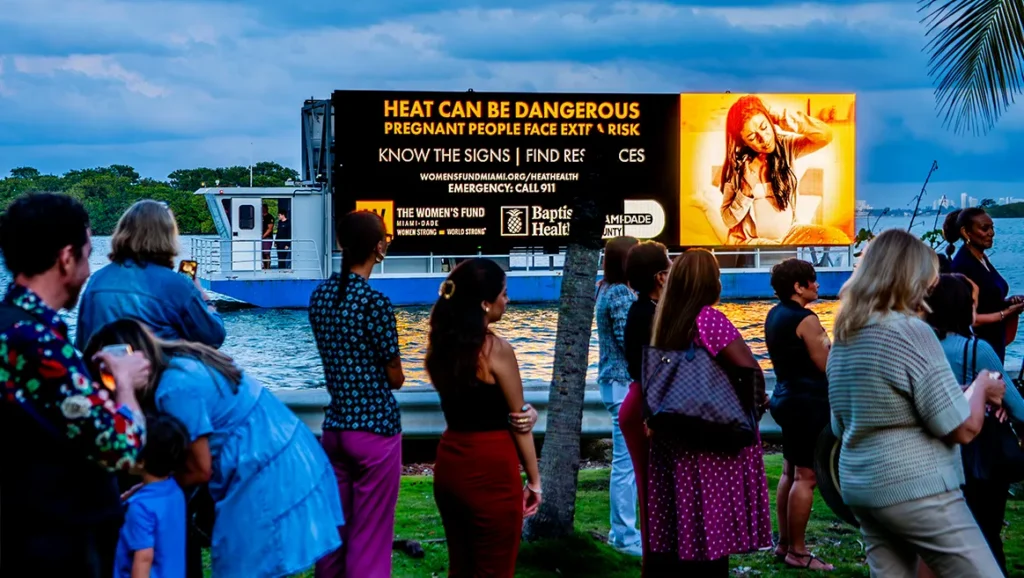
In 2021, The Women’s Fund Miami-Dade set out to change that. With their ongoing Heat Health and Awareness campaign, the nonprofit has helped shift public awareness around the risks of extreme heat during pregnancy—and what to do about it—reaching communities across Miami-Dade County through billboards and bus shelter signage, a widespread social media campaign, and a network of trusted community partners.
In this Q&A, Viviana Alvarado Pacheco, Senior Director of Research & Collective Impact at The Women’s Fund, shares why Miami needed this campaign, how they strategically reached those most at risk, and what other communities can learn from their approach.
Why did the Women’s Fund decide to specifically focus on the impact of extreme heat during pregnancy?
My academic background focused on the intersection of gender and climate change, so I was really pushing for us to do something in this space. In 2020, we hosted a convening around women’s health and climate, and one of our panelists was an expert on pregnancy health and extreme heat, Skye Wheeler at Human Rights Watch. She brought this issue to the table for us, and it was so enlightening. We realized that if we weren’t aware of the impacts, the broader community certainly was not. You didn’t really hear much about keeping pregnant people safe during extreme heat.
So we understood that it was important, but that people were not talking about this. And because Miami is ground zero for a lot of the effects of climate change, we had to really be at the forefront of this conversation.
There might be an assumption that people in locations like South Florida already have a strong awareness of extreme heat and how to protect themselves. From your perspective, what’s the reality?
People make a lot of assumptions about Miami, and they think, “Well, it’s always been hot here. It’s just another day in Miami.” And I think that’s the problem. Yes, it’s always been hot—but it’s getting hotter, and people don’t recognize that it’s not the same type of heat. As a result, they don’t take the precautions that are really needed.
In 2024, Miami observed 60 days with a heat index at or above 105 degrees. What is really dangerous is the combination of the high temperatures and humidity that is so prevalent in Miami. It might be 95 degrees, but the heat index will reach 105 or more because of the humidity. And that’s what increases risks—your body tries to regulate itself through sweating, but the humidity makes it less effective at cooling. You become dehydrated more quickly, and you’re more vulnerable to suffering heat stress or heat stroke.
Our working paper on extreme heat noted that while heat affects everyone, it amplifies the effects of systemic inequities in housing, neighborhood density, community infrastructure, and economic opportunity—contributing to an unequal burden of dangerous conditions for those from marginalized groups and with lower incomes. From your perspective, how does that play out across Miami-Dade?
It was important for us that people understood what populations experience the effects of extreme heat the most. There is a range of factors that influence how you experience heat, from the tree canopy to the affordability of electricity to even the ZIP code you live in.
“A range of factors influence how you experience heat, from the tree canopy to the affordability of electricity to even your ZIP code.”
In the United States, there’s more access to air conditioning than in Europe, where we saw a lot of deaths during a heat wave this summer. But people don’t realize that many of our more affordable apartments do not have AC. And Miami and Florida have some of the highest electricity costs in the country, so many communities cannot afford to run AC.
These tend to be the same economically disadvantaged communities that also have less tree canopy, which exposes them to more heat. When we look at maps of the tree canopy and heat vulnerability in Miami-Dade, you’ll see such a stark difference between [very affluent] Coral Gables, for example, where it is filled with trees, and Hialeah, a [lower income] city with a majority Hispanic population and very little shade. These more economically disadvantaged areas also tend to have a lot of agricultural workers—many of whom are women and are pregnant—who are at increased risk while working outdoors.
And when you put that map next to a map of preterm births in Miami-Dade County, you’ll see a direct correlation between where these preterm births are happening and the amount of heat those areas are exposed to.
Tell us about creating the Heat Health and Awareness campaign. How did you decide on this type of campaign, what messages to share, and where to place them?
It was really collective work. We convened a group of 12 organizations focused on health and climate-related topics and met monthly to develop the campaign. We then partnered with a marketing company to create the imagery and messages around heat and pregnancy health.
“We know that more women than men take public transportation, and bus shelters in Miami are often not shaded. So it was important to have messaging in those places where pregnant people are more at risk.”
Part of our model is that we don’t want to just raise awareness of an issue—we want to give solutions. So we created a dedicated webpage—womensfundmiami.org/heathealth—for people to find resources and information on how to stay safe. And we included that website on all our public awareness campaigns.
Language accessibility is also extremely important because of our very diverse community, so we made sure the awareness campaign was in three main languages of Miami: English, Spanish, and Haitian Creole.
Then we worked with a company to place the campaign in strategic places, such as messaging on the metro system, billboards in areas to the west and south of the county where there’s less shade, and bus shelters. We know that more women than men take public transportation, and bus shelters in Miami are often not shaded. So it was important to have messaging in those places where pregnant people are more at risk.
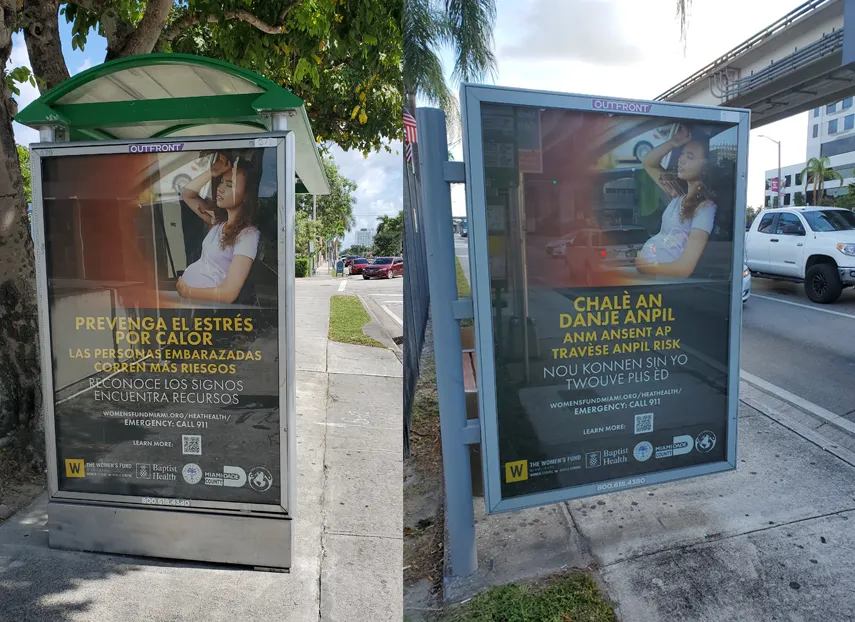
We then held a press conference in 2021 with both the mayor of the City of Miami and the mayor of Miami-Dade County to announce the campaign.
Since then, we’ve also run a social media campaign every year. And we’ve continued to disseminate the campaign through our partners, such as those in our Alliance for Infant and Maternal Health collaborative—OB/GYNs, midwives, doulas, and community health workers at our largest health systems, who meet with pregnant people every single day.
We also worked with an organization called WeCount!, a member-led organization for immigrant workers and families, to help spread the message to agricultural workers. And we’ve focused on disseminating our message through childcare centers—not only to reach the mom who is dropping off her two-year-old and expecting another baby, but to raise awareness among center staff that young children can also be susceptible to the effects of extreme heat.
What can other communities and organizations learn from your approach—especially those working with limited resources?
Billboards and outdoor campaigns can be expensive, and there isn’t always the budget. But using social media, digital platforms, and community partners can be an effective, low-cost approach to disseminating your message. For some people, receiving the message through a trusted community leader—like a WhatsApp chat from their church—can actually be the most impactful route.
It’s also been important for us to make sure that other cities know about this campaign so that they can replicate it in a way that fits their unique community, whether that’s focusing on different languages or adjusting the message to be more culturally appropriate for them.
In 2021, Miami-Dade County appointed the world’s first Chief Heat Officer (CHO). Since then, more cities have created Chief Heat Officer positions to help protect their residents against the effects of rising temperatures. How can the role of CHOs help shape the local response to extreme heat, particularly in terms of young children and expectant parents?
5 Ways to Protect Pregnant People and Young Children From Extreme Heat
Beyond raising awareness, policymakers and community leaders can take steps to reduce the risks of extreme heat during pregnancy and early childhood:
• Develop heat action plans. Heat action plans, which coordinate local government response with other agencies, health care facilities, and community organizations, can specifically address the needs of young children and expectant parents.
• Prioritize places where people spend time during pregnancy and childhood. Childcare programs, K-12 schools, and homes should be evaluated for their ability to protect people from exposure to excessive heat.
• Increase green space. Expanding tree canopies and surfaces covered with vegetation can decrease air temperatures and provide shade.
• Install air conditioning and other cooling mechanisms. Some states offer subsidies on air conditioning to residents with low income. Less-expensive solutions also exist, such as heat pumps.
• Provide support for affordable, reliable access to the power grid. In some areas, pediatricians can help families document the medical necessity of maintaining access to utilities; health insurance may even pay for utility bills.
To learn more, view our Guide to Extreme Heat and Early Childhood, including our working paper, InBrief, and Solutions Spotlight with more actionable strategies.
We were very excited to have the first Chief Heat Officer, and it made a lot of sense for Miami. Even with very limited resources, Jane Gilbert did so much to elevate extreme heat as a health issue for our community. Her team developed the county’s extreme heat plan, as well as many of the maps and resources that we use today. They developed trainings for emergency management personnel, like the fire department, to better understand signs of heat stroke or heat stress. They also designated more cooling centers, such as libraries, and trained staff to make sure they knew how to respond in an emergency. Jane did a lot of fantastic work and really made sure that populations like young children and pregnant people were highlighted in the conversation.
We no longer have a Chief Heat Officer, which is unfortunate—because extreme heat is not getting better; it’s only getting worse. And you need a designated person who understands the science, the social and health repercussions of heat, and the solutions for the community.
As temperatures continue to rise in Miami-Dade and across the country, what gives you hope?
There has been such a big shift in how the community talks about the issue—not just during pregnancy, but extreme heat in general—and that really gives me hope. The community understands the harmful effects of heat. There’s also been at least one policy change: pregnant people are now explicitly included in emergency management messaging, such as in extreme heat alerts and in the county website’s safety information.
At the state level, it’s very difficult in Florida to pass any type of policy around environmental safety. But at the local level, elected officials are the first to talk about heat and health and climate impacts. Even if they may disagree on how they talk about the environment or climate change, they are very much aware of environmental degradation—because they see it, and they feel it.
So even though we’re faced with a lot of challenges, I find optimism in the way that the community itself is taking matters into their own hands and finding solutions to address the issue. That has been such a special thing to see in Miami.
The Center on the Developing Child is committed to elevating a variety of perspectives around supporting healthy development in the earliest years. The views and opinions expressed by Policy Q&A subjects are those of the individual and do not necessarily represent those of the Center.