SNAP
SNAP (Supplemental Nutrition Assistance Program), the largest federal anti-hunger program, provides low-income households with monthly funds to purchase groceries.
- SNAP supports about 1 in 5 US children1
LaMonika Jones of the Food Research & Action Center shares how nutrition assistance programs provide critical support for young children and their caregivers.
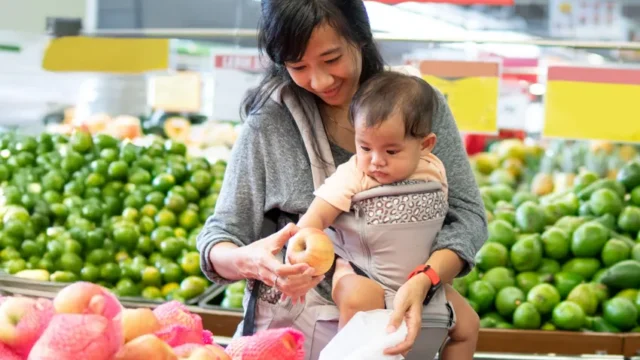
In our Policy Q&A series, we’re featuring a diverse array of perspectives on the many ways that science, community expertise, and lived experience can inform policy and program design to support healthy development during the earliest years.
Stability across the web of influences in children’s lives is critical for their healthy development. Reliable access to nutritious food represents an important thread in that web, and it is particularly important during pregnancy and early childhood, when children’s brains and bodies are rapidly developing and therefore especially sensitive to influences in their environment.
In the United States, more than 13% of households experience food insecurity, or unstable access to nutritious food. The burden is even greater among families with infants and young children: Nearly 17% of households with children under age six experience food insecurity.

Federal food programs like the Supplemental Nutrition Assistance Program (SNAP) can provide critical support; currently, more than 60% of SNAP participants are in households with children. But disruptions in coverage—due to eligibility requirements, changing policy environments, or other challenges—can be a significant source of instability for children.
LaMonika Jones, Director of State Initiatives at the Food Research & Action Center (FRAC), is dedicated to increasing participation in child nutrition programs, as well as advocating for policies that strengthen assistance and address the root causes of food insecurity.
In this Q&A, Jones shares how nutrition assistance programs provide critical support for young children and caregivers, how food insecurity connects to broader economic instability, and how policy solutions can help build lasting stability for families.
Nourish From the Start
The Food Research & Action Center helped develop the Nourish From the Start policy agenda, which provides a roadmap for strengthening federal nutrition programs for prenatal-to-three families. Visit the National Collaborative for Infants and Toddlers website for key policy recommendations, practical solutions, and more resources for taking action.
FRAC is a national organization that focuses on ending hunger across the country, with a particular focus on policy and permanent solutions. Our big focus is supporting families—especially families with young children and low-income households—analyzing data, and working with elected officials to determine solutions that will support all families experiencing food insecurity and address the root causes of hunger.
My work specifically covers D.C. Hunger Solutions, New Jersey Food Security Initiative, and Maryland Hunger Solutions, which are grassroots anti-hunger organizations focused on those jurisdictions. We work to maximize participation in federal nutrition programs—helping households with eligibility and enrollment in SNAP and WIC [Special Supplemental Nutrition Program for Women, Infants, and Children], as well as working closely with our schools to put together policies and solutions around school meals. We also produce reports and serve as a thought leader on the state of hunger and what’s happening on the ground when it comes to households experiencing food insecurity.
Food insecurity is the inability of an individual or a household to access food on a regular basis. When we say someone is food insecure, it’s not a complete absence of food. It could mean they only had breakfast today, or only had an apple, or they don’t know what they’re going to have for dinner or if it will sustain them. It’s the absence of a secure, reliable source—of knowing where your next meal is going to come from.
Our latest data—from the USDA 2024 Household Food Security report—shows that more than 13% of households in the US are food insecure. We’re concerned that food insecurity has increased since then, and, as we look to the future, we’re concerned about what the impact of changing policies and eligibility for different federal programs will be on families.
SNAP
SNAP (Supplemental Nutrition Assistance Program), the largest federal anti-hunger program, provides low-income households with monthly funds to purchase groceries.
WIC
WIC (Special Supplemental Nutrition Program for Women, Infants, and Children) provides infants, children under five, and adults during pregnancy and postpartum with healthy food, plus nutrition education, breastfeeding support, and other services.
CACFP
CACFP (Child and Adult Care Food Program) provides reimbursement to childcare centers and other programs for serving meals and snacks that meet nutrition standards.
SNAP is our primary defense against hunger—it’s a resource that low-income, food-insecure households rely on to purchase food. CACFP helps childcare centers offset the cost of meals, ensuring they can offer healthy, nutritious meals to their littlest eaters. WIC recognizes the impact of early childhood nutrition from the prenatal stage through age five. These programs are designed to make sure we’re addressing the complexities of these households and what food security looks like at every stage.
The households that will be impacted most by the loss of SNAP benefits include older adults on fixed incomes, veterans, those with disabilities, unhoused residents, refugees—and especially households with small children. This is not new, and it’s similar to what we saw during the pandemic: The same households, and the same families, continue to be most impacted regardless of what decade, what year, or what administration we’re in. That’s why we have to look at permanent solutions to end hunger.
“That’s why we push for taking care of the whole child—and that includes their parents.”
In Maryland, for example, close to 40,000 residents have already lost access to SNAP since July 2025. We’ve seen the cost of groceries increase steadily, and many families already have high childcare and housing costs. Without the additional support that SNAP provides, households will have to figure out how to further tighten budgets that are already very limited.
It will have an impact on households—but it will also have reverberating impacts on our entire system. For example, if someone diagnosed with type 2 diabetes is unable to modify their diet because they don’t have access to nutritious food items, we’re going to see health care costs go up. We’ll see more folks struggling to manage various conditions. More kids will show up to school and childcare on empty bellies, which can affect learning. Our schools will need more funding to provide breakfast, lunch, and snacks during the day. And there will be an increased need for charitable food organizations to try to fill the gap. We’ll see a greater strain on our food system that is just impossible to make up for.
This affects caregiving, too. Many times, parents will forgo their own meals to ensure their children can eat. But you can’t be the best you can be for your child if you’re hungry yourself. That’s why we push for taking care of the whole child—and that includes their parents.
Even before some of the current challenges, we’ve seen an increase in households that are experiencing food insecurity but don’t fit the eligibility requirements for SNAP. They are denied for SNAP benefits because of income reasons—they’re employed and making just slightly above the income threshold—or because they own their home and don’t meet the asset limit test. But this doesn’t mean that they are food secure or have regular access to food.
Another big hurdle has been the administrative burden—particularly when we’re talking about CACFP. CACFP is a reimbursable meal program—childcare providers serve a certain number of servings of fruits, vegetables, proteins, and milk, and they receive a reimbursement rate for each compliant meal. But these are federal programs, and with federal programs, there is a lot of paperwork. Childcare centers must attend trainings, complete applications, provide verification documents, prove financial viability, and maintain licenses. A lot of these childcare centers—especially our home daycares—are small businesses, and they have very tight margins. If their food costs increase, they can’t afford to hire more staff or they’ll have to charge parents more—and, particularly in rural, low-income areas, parents can’t afford to pay any more. Worst-case scenario, the centers close. So, we want to eliminate some of that administrative burden to make it easier for providers to participate in CACFP.
We experience the same burden on the school side. That’s why we push heavily for policies like Community Eligibility Provision and Healthy School Meals for All, because they make it easier for schools to serve meals to kids at no cost. There’s no need for families to submit a free and reduced-price meal application. We also push heavily for direct certification, which means if you’re a SNAP, TANF [Temporary Assistance for Needy Families], or Medicaid household, you’re automatically eligible for WIC, Summer EBT [a program that provides a grocery benefit to families during the school break], and free school meals.
When we think about solutions for food insecurity, we have to look at families’ economic stability. I always say, “the rent eats first”—households are unable to afford food on top of all their other costs, like housing and childcare. It comes down to the cost of living and whether households are being paid fair and equitable wages to support their families. A lot of households receiving our food programs reside in areas that are chronically underserved with high unemployment rates and a lack of jobs. And this impacts communities of color in ways it does not impact other communities.
“When we think about permanent solutions, we have to think about the root causes of hunger. We can’t silo ourselves in food.”
So when we think about permanent solutions, we have to think about the root causes of hunger. We can’t silo ourselves in food. Making all school meals free is great—but that’s just one burden alleviated for parents during the school year. We still have to think about other issues, like the cost of transportation and health care for our children. It’s looking at solutions like universal basic income and the child tax credit. It’s making sure there are ample education and workforce development training programs and pathways to economic security. It’s making sure that our leaders at the state, local, and federal level are really analyzing why a household is consistently relying on SNAP, TANF, WIC, and free school meals, and putting forth solutions that are going to address all of this as a whole on a permanent basis.
The answer is always going to be in the permanent solutions—and we’ll have to keep reworking those solutions until every single person has dignified access to food.
One of the things I’ve been really hopeful about, and that I’ve seen a lot since the pandemic, is the response at the local level within our states and communities. Our mayors and governors have heard the voices of their residents and advocates, and they’ve dedicated resources to make sure families have what they need, in light of everything going on at the federal level—such as local funding for programs at schools that provide families with fresh vegetables. This community-level response—our local leaders and boots-on-the-ground advocates coming together—is what I’m most hopeful about, and I know it will continue in the future.
The Center on the Developing Child is committed to elevating a variety of perspectives around supporting healthy development in the earliest years. The views and opinions expressed by Policy Q&A subjects are those of the individual and do not necessarily represent those of the Center.
References