Policy Q&A: The Importance of Providing Stability—and Play—for Young Children Experiencing Homelessness
Kate Barrand of Horizons for Homeless Children discusses how housing instability affects young children—and how programs and policies can buffer against the impacts.
In our Policy Q&A series, we’re featuring a diverse array of perspectives on the many ways that science, community expertise, and lived experience can inform policy and program design to support healthy development during the earliest years.
For young children, stability is an essential part of a healthy developmental environment. From consistent caregiver relationships to predictable routines to a safe place to call home, stability across a wide range of factors supports early development and lifelong health. By contrast, instability in a young child’s life can disrupt healthy development. Restoring stability after periods of disruption offers an opportunity to avoid or even reverse potential harm, supporting improvements in behavior as well as cognitive and emotional development.
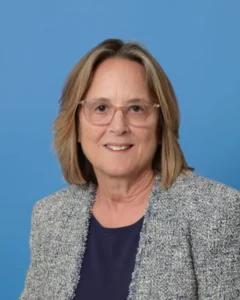
Kate Barrand, president and CEO of Horizons for Homeless Children
For young children experiencing homelessness, instability can impact many areas of their lives. Horizons for Homeless Children is committed to buffering against those impacts through high-quality early education, comprehensive family support, and opportunities to play. Play is essential to healthy development: Simple, playful interactions with adults help children develop sturdy brain architecture, core life skills, and resilience against adversity. But for children experiencing homelessness, time and space for play can be scarce. Horizons’ Playspace program, located in more than 50 emergency assistance shelters across Massachusetts, provides a dedicated environment for children to find joy, make meaningful connections with consistent volunteers, and develop through the power of play.
In addition to its shelter-based Playspaces, Horizons operates a state-of-the-art early education center serving more than 260 children in the emergency assistance system. This trauma-informed program is designed to address the unique needs of young children experiencing housing instability—and is rated among the top 10% of early education programs in the country by the National Association for the Education of Young Children. Horizons also offers family coaching and comprehensive support services to help caregivers achieve stability, and advocates for new state policies to end family homelessness.
In this Q&A, Kate Barrand, president and CEO of Horizons, shares how she has seen homelessness impact young children, why housing is fundamental to family stability, and how policies and programs can make a difference for young children and their caregivers.
You’ve led Horizons since 2015. How have you seen the issue of family homelessness change over the last decade?
In my 10 years, we’ve seen three very different periods. From 2015 to 2019, there was a slight decline in family homelessness across the country. Then the pandemic hit, and we [as a country] did some really good things: We had eviction moratoriums, rental assistance, and stimulus payments. If we had kept those programs going, I believe our children would be in a much better place. Unfortunately, that all went away post-pandemic, and we’ve seen a massive acceleration in family homelessness. Across the country, family homelessness increased nearly 40% in 2024 [compared to the previous year]. Half a million infants and toddlers are experiencing homelessness—and that’s just wrong.
What are the impacts of homelessness on young children? Why is it so critical to strengthen stability during early childhood?
“During those first five years, children do best with stability, consistency, routines, and a life of plenty.”
If there’s one period of life that is critically important to humanity, it’s the first five years. That is when the structure of the brain is built. And during those first five years, children do best with stability, consistency, routines, and a life of plenty—plenty of access to things like food, physicians, and an available parent. Housing is one of the most fundamental building blocks. By its very nature, housing has a stabilizing effect: A child knows where they’re going to wake up and go to sleep.
When you don’t have a home, everything is disrupted. Without a home base, it’s very hard to seek childcare, obtain health care, or navigate the other critical aspects of your life. So there’s a multiplier effect: homelessness is clustered with issues like food insecurity, lack of health care, and parental stress. And when a parent is operating under acute stress, that impairs their ability to provide the serve and return interactions, calm, and consistency that children need during those earliest years.
We see that in the outcomes. About 50% of children under 4 experiencing homelessness show developmental delays, which is about three to four times higher than their housed peers. We see delays in language, literacy, social and emotional regulation, and gross motor skills. Those higher rates of developmental delays and other issues compound over time if we haven’t mitigated them by the time a child reaches school. That’s why it is absolutely vital that children experiencing housing instability get the highest-quality childcare they possibly can, for as long as they possibly can. We’ve seen the gap narrow in children when they’re here at Horizons. That’s been exciting for us—that there’s evidence that we can reduce some of these serious delays.
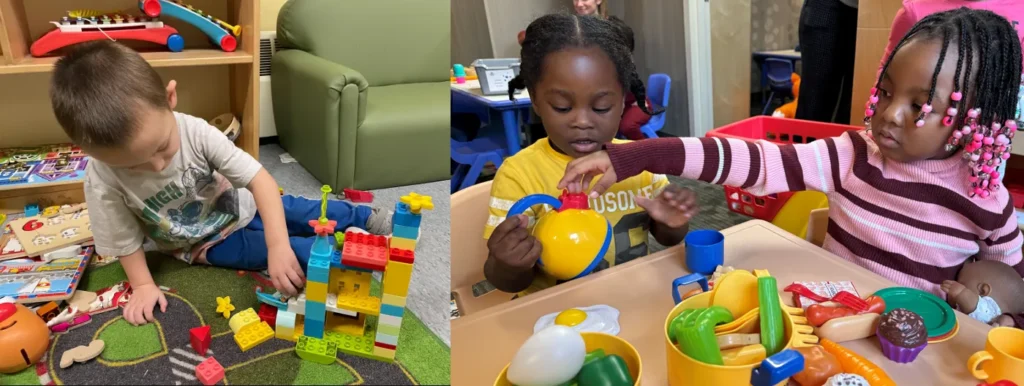
Children play at one of Horizons’ Playspaces, located in more than 50 emergency assistance shelters across Massachusetts.
Along with high-quality early education, Horizons puts an emphasis on providing young children experiencing homelessness with opportunities for play. How does Horizons see play as fundamental to child development?
Play is essential for everything that a child learns. It supports their brain structure. It supports their memory development and skills like executive function. It’s how they learn to regulate emotion. To me, play is an overly simple word for a highly complex array of things that a child learns.
It’s fascinating to watch these interactions in our classrooms. We’ll see children who, for example, can now self-regulate when someone grabs their toy, because they’ve learned how to manage their emotions. They’ve learned empathy and cooperation through the process of play.
Previously, there was little in the emergency shelter system dedicated to children. I’m proud to say that in the last five years, we’ve worked with the state of Massachusetts so that it’s now a requirement that every shelter must have a place for children to play.
How are Horizons’ programs designed to meet the needs of young children experiencing homelessness?
Everything we do is with intention, and it’s all based on research and our understanding of child development.
We know that one of the most important things to children is consistency, so everything in the classroom is grounded in routines and consistency with their teachers and caregivers. More importantly, we’ve ensured that our environment is fully trauma-informed. Our entire staff—not just our teachers—are trained in our core curriculum, which includes trauma-informed practices. Part of that is about respecting the parent’s role as the first teacher. When people are housing-insecure, it’s really important that they don’t feel like they failed. We want them to feel empowered, knowledgeable, and the expert of their child.
We also intentionally have lower student-teacher ratios in our classrooms to reflect the needs of our kids. And we’ve put a tremendous focus on social and emotional regulation as the bedrock of learning.
Because of the beauty of our diverse population, we also make sure that the people who work here represent and speak the language of our communities. All our classrooms have Spanish-speaking teachers, and we’ve begun to hire more Haitian Creole-speaking teachers. Everything about our program is intentionally aligned with the demographics of the families we serve.
Horizons has also put a lot of thought into the physical space. How are the Playspaces and early education center specifically designed to support young children experiencing homelessness?
“Everything is done very intentionally to support play and learning, but also to be predictable and routine for the children. So if you walk into the space, that little red truck that you like so much is going to be on the same shelf, every day.”
We built our early education center in Roxbury to inspire our families and our workforce with lots of natural light, art, and soothing colors. And I can’t tell you the difference it has made in how our families and staff show up, and how they interact. Where you serve people matters. It sends a strong message about what you believe they are capable of, and it is particularly important in trauma-informed work.
We think about this in the design of our Playspaces as well. We think about how children move through spaces, and we have predictability in how things are set up. Because when life gets unpredictable and unstable, the more predictable and stable you want your environment to be. There are five intentional areas of play, such as one around literacy, one around art and creation, another with puzzles and blocks. Everything is done very intentionally to support play and learning, but also to be predictable and routine for the children. So if you walk into the space, that little red truck that you like so much is going to be on the same shelf, every day.
Our Playspaces are open play, and that’s important, too, particularly in shelters: We want to give children self-efficacy and control to explore and use their imagination. When they go into that room, they get to define how they play. Perhaps, at that moment, it’s the only place in their life where they really get the freedom to do that.
Relationships with caregivers can be one of the most powerful buffers against childhood adversity. How does Horizons also support the needs of parents and caregivers experiencing homelessness?
We’ve always been a two-generation model. We understand that children grow up and prosper in relationship with a parent, so we’ve built a community that supports parents’ success as well as their children’s.
About 30% of parents experiencing housing insecurity experience depression. So we have a medical clinic on site with mental and family health services. We also have ESOL [English for Speakers of Other Languages] and job training programs. We have a class that teaches families financial planning and how to set up a budget.
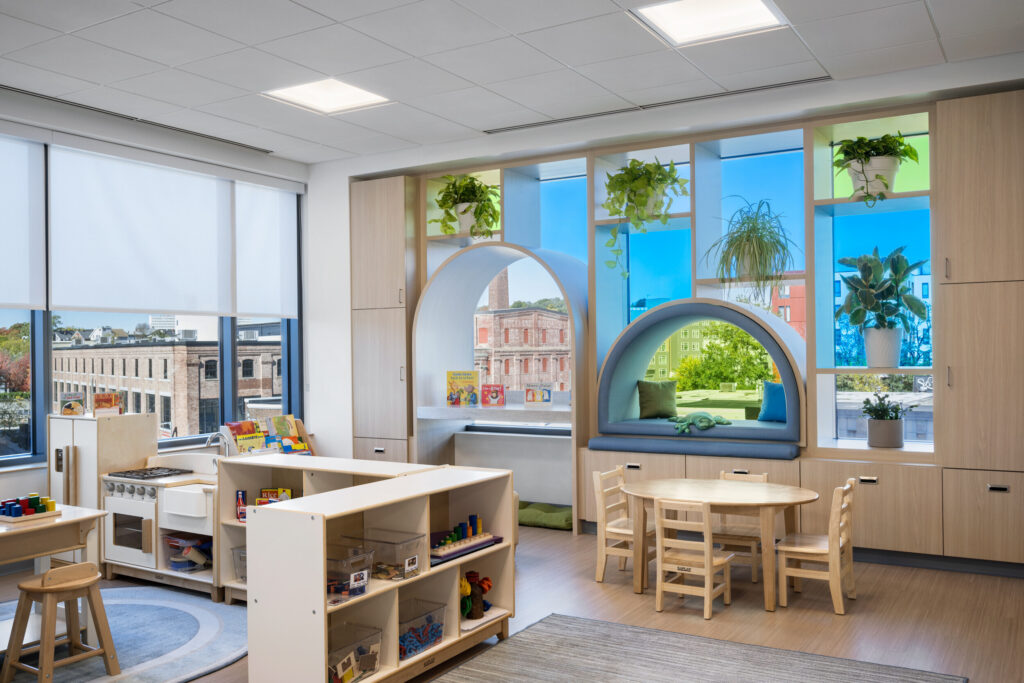
A classroom at Horizons’ early education center in Roxbury.
All parents at Horizons receive coaches, and they work together on setting goals around key elements of their life—like housing, education, and employment—that will help lead to more economic mobility and stability. We try to help parents find their own voice and approach to problem-solving. We aren’t directing people on how they should live their lives. We try to say, “We know you need to line up housing, childcare, a job, etc. How can we support you in finding opportunities within those areas?”
As one example: We had a single mom who had been supporting her family, but due to an illness where she couldn’t work, things spiraled out of control, and she ended up in a shelter with her two kids. She started working with a coach at Horizons, and they identified that she was passionate about cooking and quite good at it. She got excited about starting her own food catering service. And she did, and she’s been very successful at it. She’s making a living in the city of Boston. Her two children have gone through Horizons and are now doing quite well. She has a means of support that she is passionate about—and life has settled.
There are so many times when success is possible if we just give folks a chance and a support system. So we encourage our parents, we believe in their capacity, and we keep feeding them with their strengths—as opposed to coming at it with a deficit mentality.
Horizons is also dedicated to supporting families through policy and advocacy work at the state level. What are Horizons’ policy priorities, and how would they benefit young children and families?
We’ve been trying to pass a bill for many years, House 5090. It says that young children should be assessed for early intervention services upon arrival at a shelter. Because we know that these children are more likely to have developmental delays—and with a small bit of intervention, they can be greatly helped. This just got put into the House budget, which would be wonderful. And I’m feeling like we might finally get this over the finish line.
Another area we’ve recently focused on is creating proofs of concept for policymakers. For example, during the crisis around immigration, where families were in hotels, we worked with the state to launch a pilot: there was one person in the shelters whose only job was to get kids services—we call them “navigators.” We collected data about the kids who had the navigator support and the ones who didn’t. And we showed very clearly that this role really moves the needle when it comes to getting kids services. The state has since adopted that role throughout the shelter system. That’s a win.
“I think it’s really important that if you do this work, you always ask yourself: ‘How can we make this better for children, and how can we make it better for families?’”
We just received a grant to try another pilot: we’ll have an early intervention specialist in our facility full time so that they become a familiar part of our world. While early intervention services [such as speech or physical therapy] are typically based at a family’s house, we want to put it in the early education system to make the process easier for families to access and more stable for kids. We hope that in a few years, we’ll have proof of concept that this pilot successfully narrowed the gap when it comes to children accessing services.
What’s encouraging to me is that we’ve created a culture at Horizons where we’re never satisfied with the way it is—given what these families are up against. So many systems that families interact with are just impossibly difficult, and can often be demeaning and demoralizing. And it’s our children who pay the price. So I think it’s really important that if you do this work, you always ask yourself: “How can we make this better for children, and how can we make it better for families?”
The Center on the Developing Child is committed to elevating a variety of perspectives around supporting healthy development in the earliest years. The views and opinions expressed by Policy Q&A subjects are those of the individual and do not necessarily represent those of the Center.